
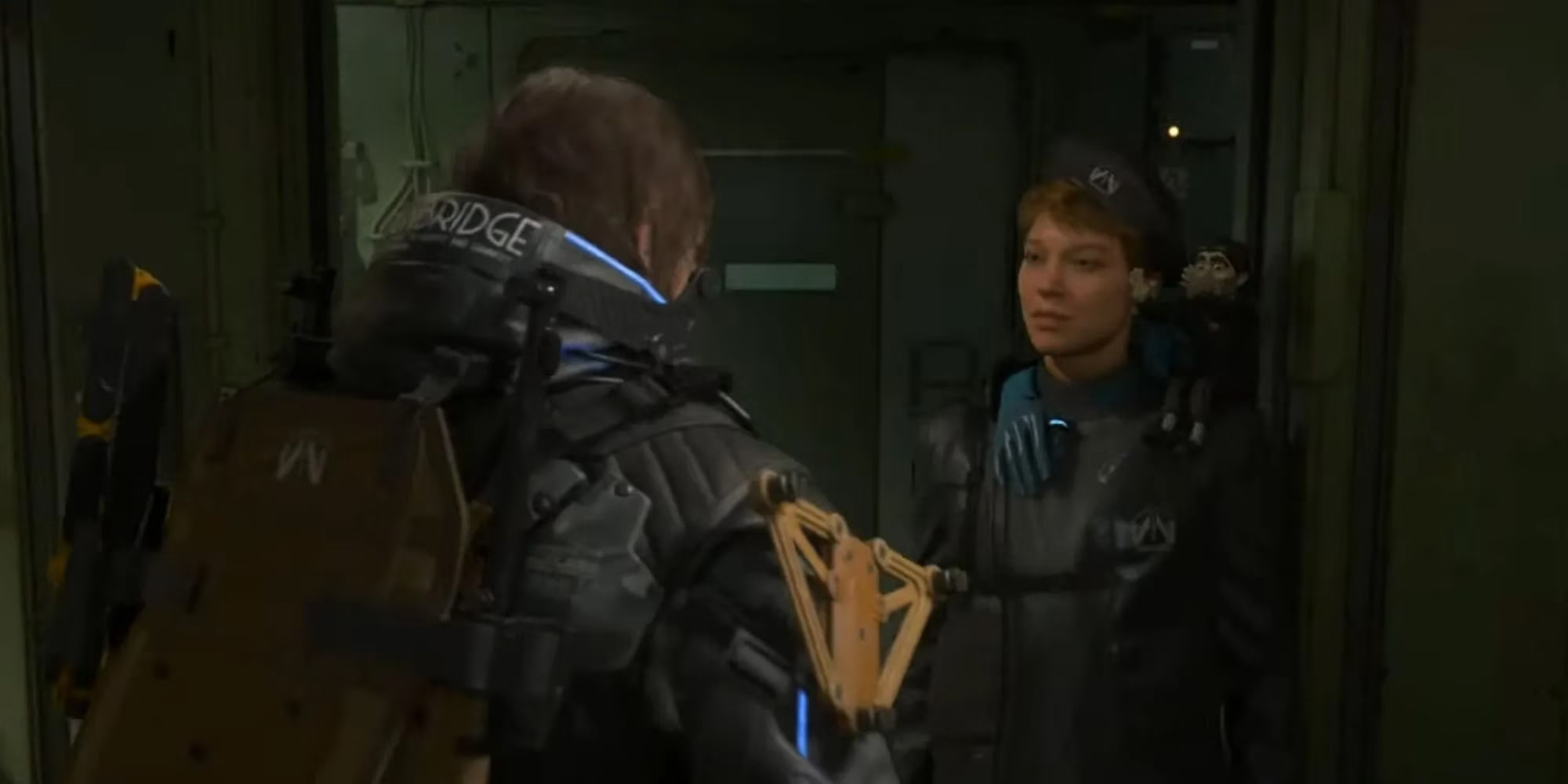
So, here we are in 2026, and the gaming world is still trying to wrap its head around Hideo Kojima's latest mind-bender. Recently, a ten-minute glimpse of Death Stranding 2: On The Beach was shown, and honestly? It left everyone with more questions than answers. What's the deal with that puppet? The baby? An electric guitar that shoots lightning? And why is George Miller involved? 🤯 For someone who doesn't fully 'get' Kojima as an artist, there's an undeniable appreciation for his sheer existence in the industry. He's a creator who operates on a different wavelength entirely.
🎬 The Cinematic Auteur in a Gaming World
On paper, Kojima should be a perfect match for cinephiles. He loves movies with a passion that goes deeper than most modern games' superficial attempts at cinematic assimilation. Think about it: he's not trying to make games 'respectable' like films; he's genuinely, emotionally moved by cinema itself. His game-making process feels less like coding and more like Diego Calva tearing up during the final montage in Babylon—it's raw, emotional, and deeply personal.
Yet, for many players, this theoretical connection doesn't always translate into an immersive gaming experience. Liking the same cult classic, Barbarella, doesn't automatically make traversing Kojima's worlds any more engaging. It raises a question: is the 'Kojima experience' more about the idea of his artistry than the playable reality?
🧩 Beyond Plot: Storytelling as Emotion and Vibe
Where Death Stranding 2 truly diverges is in its approach to narrative. The trailer isn't setting up a traditional plot with a clear beginning, middle, and end. It's not even strictly 'non-linear' storytelling in the way we usually discuss it. Instead, it presents:
-
Events that feel symbolic rather than explanatory.
-
Emotions as the primary driver, not plot points.
-
Vibes over coherent lore dumps.
It's asking a different question. Not "Do you understand what's going on?" but "Do you feel it?" This approach allows for wild, seemingly disconnected ideas to coexist. Maybe they'll connect, maybe they won't. The point isn't to map every narrative corner, because maybe Kojima hasn't either. Perhaps this is just how he feels, and the game is the vessel for that feeling.
This philosophy echoes other idiosyncratic artists. Take Wes Anderson's Asteroid City (2023), a story within a movie of a play within a play. When a character confesses, "I don't understand the play," the director simply replies, "Just keep telling the story." That's the vibe here. When storytelling is an expression of internal emotions—fear, grief, hope—it doesn't need to conform to a three-act hero's journey. You don't need to understand it intellectually; you just need to experience it.
⚖️ The Auteur Worship Dilemma & The Need for Boldness
Let's be real: the games industry has a major problem with auteur worship. There's a tendency to credit the work of hundreds to a single famous name like Kojima or Neil Druckmann. Remember The Game Awards a few years back? Kojima got a lengthy segment while actual award winners were played off stage. It's emblematic of putting creators on untouchable pedestals.
This culture leads to a toxic side effect: any criticism of Kojima's work is often dismissed as simply 'not getting it.' Even the author of the original piece did this to themselves in their opening! It creates an environment where the artist is placed beyond critique, which is unhealthy for any art form.
However, and this is a big however, the work itself shouldn't suffer because of how we talk about the creator. In an era where big-budget games are becoming increasingly safe, risk-averse, and bland—often because audiences themselves reject complexity—Kojima's unbridled wildness is a breath of fresh, bizarre air.
| Industry Trend | Kojima's Response in DS2 |
|---|---|
| Safe, formulaic open worlds | A poetic, fragmented 'strand' narrative |
| Clear, digestible lore | Emotional resonance over exposition |
| Familiar gameplay loops | A shoulder puppet & a lightning guitar 🎸⚡ |
That last point is key. In a landscape of homogenized sequels, the mere idea of a stop-motion puppet companion that sits on your shoulder feels revolutionary. It's the sort of bold, inexplicable creative swing that the medium desperately needs to avoid stagnation.
🔮 Looking Ahead to The Beach
So, what's the takeaway as we await Death Stranding 2's release? It's okay to be confused. It's okay to have questions that may never get answers. The game will undoubtedly receive a mixed bag of criticism upon launch—some of it will be valid and worthy, some of it will miss the point entirely.
But at this stage, in the realm of pure potential and untamed ideas, there's something beautiful about Kojima's vision. He's not making a product designed by committee to maximize player retention. He's crafting an experience, a feeling. Whether that feeling connects with a wide audience is almost secondary to the fact that someone with his resources is allowed to try.
In the end, Death Stranding 2: On The Beach may not be a game you 'play' in the traditional sense. It might be a game you feel, you endure, and you interpret. And in 2026, with AI-assisted development and data-driven design on the rise, that kind of stubborn, human, emotional weirdness might just be the most important thing in gaming. Now, if you'll excuse me, I need to go finally finish the first game before this sequel breaks my brain completely. 🧠💥
Data referenced from SteamDB helps contextualize why a deliberately “vibes-first” sequel like Death Stranding 2 can thrive amid a market that often rewards familiar loops: by tracking real-time player activity trends and release-era momentum across major PC titles, it underlines how attention can surge around games that spark curiosity and conversation—even when their storytelling is fragmented, symbolic, and more about feeling than plot.