
I have a confession: my first run through Death Stranding was a disaster. I was a longtime Hideo Kojima fan, salivating over his first post-Konami project like everyone else, but I bounced off it hard. I found it monotonous, needlessly obtuse, and I described it on podcasts with the kind of vocabulary that makes people wonder why anyone pays me to talk about games. Seven or eight hours in, I dropped it. I did not gracefully retire from the delivery business; I sprinted away from it while tripping over my own cargo.
Then the Director's Cut arrived, and I saw my wife playing it. She was approaching a river, scanning the water with her Odradek, carefully looking for a safer path instead of doing what I did in my original run: panic, rush, and hope the physics engine was feeling generous. That should not have been a eureka moment. Examining the land and delivering packages with caution is literally the game's whole deal. But I had rushed through Death Stranding to meet a coverage embargo, sprinting from objective to objective so I could say smart things on a podcast on time. Turns out that is not the way to play it. I gave the Director's Cut another shot, took my time, and was quickly ashamed of my words and deeds. Death Stranding is a great game.
 .jpg)
So when I got the chance to travel to Tokyo and play 30 hours of Death Stranding 2: On the Beach, I made myself a promise: no sprinting, no podcast-brain, no treating the weirdness like a problem to be solved before lunch. In 2026, with the game long since out in the wild, I can say that promise was the smartest thing I have ever done with a controller. I met the sequel on its own terms, took my time, and had a much better first experience. Shocking, I know. Patience: it works.
The opening is pure Kojima, and I mean that as a compliment
Death Stranding 2 begins with a tremendous opening sequence that tasks you with simply returning home with Lou. On paper, you are walking across precarious rocky cliffs. In practice, Kojima magic is hitting you from every angle. Triumphant chanting and drums set the tone. A gate quake strikes, boulders cascade down the hills, and opening credits flank Sam with the signature style of longtime title designer Kyle Cooper. Sure, I was walking from Point A to Point B, but I will be damned if Kojima does not make it feel cool and important.
When Sam reaches his camouflaged shelter in the mountains, we see a new life. It is 11 months after the first game, and he seems to have found something resembling peace. The shelter feels homey, borderline cozy, with happy pictures of father and daughter on the walls, toys on the floor, and Lou being fed things other than Monster Energy. Then Fragile shows up and shatters the calm, because humanity is still on the brink of extinction and the grizzled vet must be pulled back in for one more mission. It is a trope Kojima has loved since roughly 1985, and for the record, I love it too.
The Corpus glossary is the real MVP
One of the most welcome additions is the Corpus, an in-game glossary accessible at any time, even during cutscenes. It is exhaustive, explaining story, terms, characters, and mechanics on demand. No universe needs this more than this one. Within the first half hour, a character brings you the finest chiral-printed diapers, and my brain simply registered that as a normal thing to say in this world. It is like how we all eventually accepted that nanomachines could explain everything from psychics to vampires in Metal Gear Solid. The Corpus helped me understand what was going on without pretending I was too cool to ask.
Mexico, Australia, and a ship shaped like trouble
The first seven or eight hours take place in Mexico before events eventually take the crew to Australia. My remaining 20-plus hours started on the West Coast and worked east, and I was told my 30 hours added up to roughly 30 to 40 percent of the overall game. Sam soon finds himself on the DHV Magellan, a behemoth that can navigate tar currents and looks suspiciously like the top half of Metal Gear Rex. The ship hosts an expanding motley crew, and their interplay is one of my favorite narrative improvements. The first game had great characters, but interactions felt siloed: here is Heartman's house, here is your private room, here is Mama's lab. In the sequel, you frequently return to the Magellan and talk with a group, which makes the world feel less like a series of appointments and more like a found family with a tar problem.
The Magellan is piloted by Tarman, modeled on George Miller, missing a hand and suffering phantom pains for reasons you learn in a flashback. A tar-covered flying cat follows him around. A talking mannequin torso named Charlie funds the ship and Fragile's new organization, Drawbridge. Tomorrow, played by Elle Fanning, is found in a golden cocoon and eventually demonstrates spectacular abilities. And then there is Dollman, my guy, a puppet containing a human soul who hangs on Sam's belt and offers friendly advice. Every time I returned to Sam's room, I checked whether Dollman had something new to say. Pro tip: if he likes a song on Sam's music player, play it for him.
.jpg)
At one point, Dollman asked if I wondered how he maintained his youthful appearance. I did not, but I heard him out. There is a woman on the Magellan named Rainy who causes Timefall rain around her when she steps outside. Within a 1.5-meter radius, it becomes Corefall rain, which makes everything younger. So Rainy occasionally takes Dollman into the shower, and the shower water turns into Corefall. Simple! This is the kind of nonsense I now accept as normal, and honestly, it is why I keep coming back.
Delivery is less annoying, and combat is actually fun
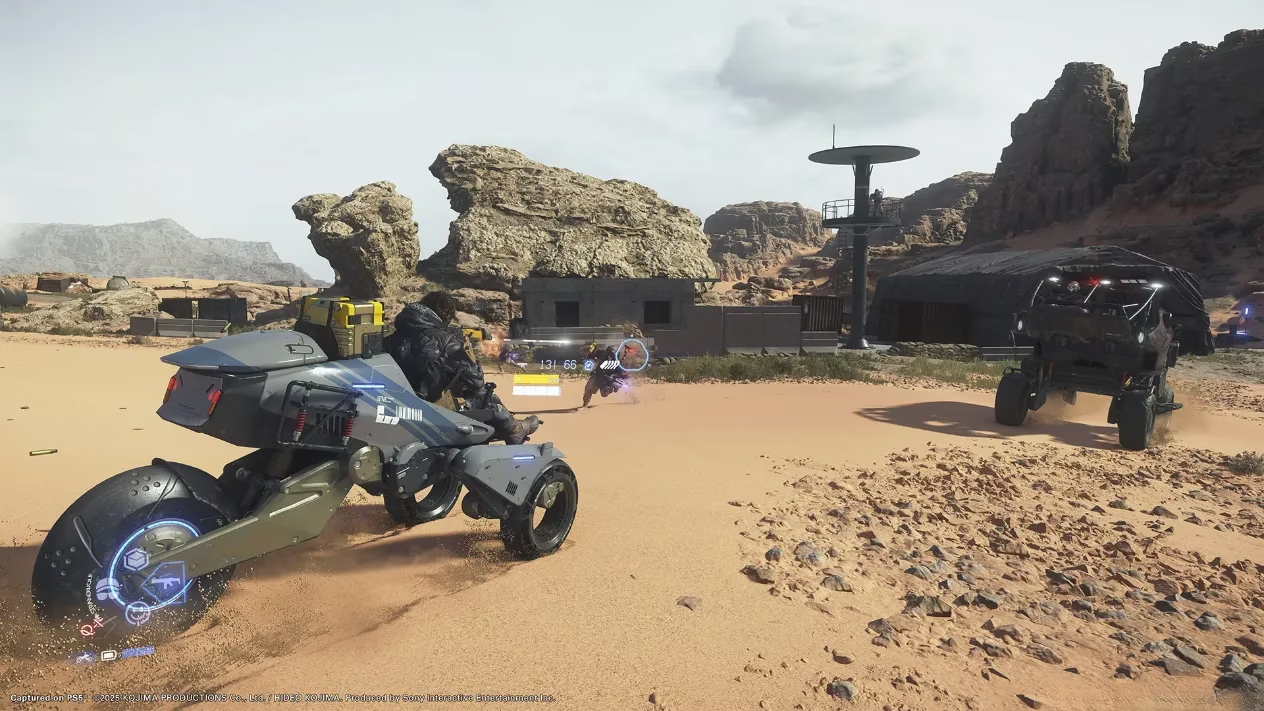
The more frustrating parts of delivering cargo are significantly reduced. I was not micromanaging my leaning nearly as much, and I rarely fell down. Lou still cries occasionally, but not with the Yoshi's Island-like frequency of the first game. I soothed her once or twice in 30 hours, and it never felt particularly necessary. Environmental features are more cool than frustrating: gate quakes rattle the earth, wind storms push you around, water levels rise during rain, chiral cinder showers fall, and forest fires vary the scenery. The first game's Iceland-looking America was beautiful, but the variety is much appreciated.
.jpg)
I also made an early mistake: I played Death Stranding 2 as if it were the first game. Lethal combat was discouraged in the original because killing enemies risked a voidout, so I routed my early deliveries around enemy camps. I avoided combat and missed an important cutscene featuring a red cyborg samurai. More importantly, I learned I should not be avoiding combat at all. Weapons are non-lethal, rubber bullets are standard, and tranq grenade launchers are the norm. Once I retrained myself to play it as a stealth-action game, my enjoyment skyrocketed. I threw Dollman into the air above an outpost and he tagged enemies and cargo like a surveillance drone. I tossed a decoy grenade that created holographic wildlife, knocked out two bandits from behind, then resorted to direct action. I dodged gunfire, performed pro-wrestling moves like a crossbody block or Kenny Omega's V-Trigger, stole cargo, loaded it onto an enemy vehicle, and drove off to cash it in. I will not say this game is Metal Gear Solid V meets Death Stranding, but it is certainly closer than the first game was.
Even BT encounters are improved. Many weapons are effective on BTs, such as the new Blood Boomerang that siphons Sam's blood and can eliminate BTs with a well-aimed headshot. Boss fights are better across the board, including an excellent early encounter with a hulking red mech. An Oblivion-style Sam's Stats feature lets skills like terrain traversal and carrying capacity level up passively, and a new skill tree can be respecced on the fly. Everything is less laborious and more fun.
| What changed | Why it matters |
|---|---|
| Corpus glossary | Explains the beautiful nonsense on demand |
| Less leaning micromanagement | I fall over less, therefore I am happier |
| Non-lethal combat focus | I can finally use the toys without fear |
| Dollman | A puppet friend, a drone, a tiny comedy engine |
| New environments | Gate quakes, storms, fires, and cinder showers |
.jpg)
One chapter titled Conflagration is one of the most visually stunning sequences I have ever seen in a game. Even on a base PS5, it is a spectacle that culminates in a boss encounter rivaling the best of Metal Gear Solid. Mechanically, it is a shootout with a boss and multiple soldiers, but tonally and visually, it is Kojima firing on all cylinders. It is jaw-dropping in the way that makes me forget I am supposed to be a cynical games writer with a podcast deadline.
In 2026, I can look back at that 30-hour preview and say it aged like fine chiral wine. Death Stranding 2: On the Beach is excellent. It is still meditative in the quiet moments, still ridiculous in the loud ones, and still capable of making a delivery run feel like a triumph. If you bounced off the first game like I did, give this one a slower, stealthier, puppet-assisted chance. And please, for the love of Lou, do not sprint past the river.
Expert commentary is drawn from Digital Foundry, whose technical reporting helps contextualize why a visually ambitious game like Death Stranding 2 can leave such a strong impression through environmental density, cinematic staging, and large-scale action sequences while still emphasizing the tactile feel of traversal and combat.