
The reveal of Death Stranding 2: On The Beach at the 2024 PlayStation State of Play sent waves through the gaming community. As the long-form trailer unfolded, players were drawn back into the hauntingly beautiful and bizarre world crafted by Hideo Kojima, following Sam Bridges on his continued mission in a fractured America. While the 2025 release promises new adventures, strange landscapes, and the return of familiar faces like Norman Reedus's Sam and Léa Seydoux's Fragile, one element immediately captured the attention of long-time Kojima devotees: the emergence of a sleek, deadly robotic ninja. This was not just another machine in the post-stranding world; it was a direct and loving callback to a legacy that defined a genre.
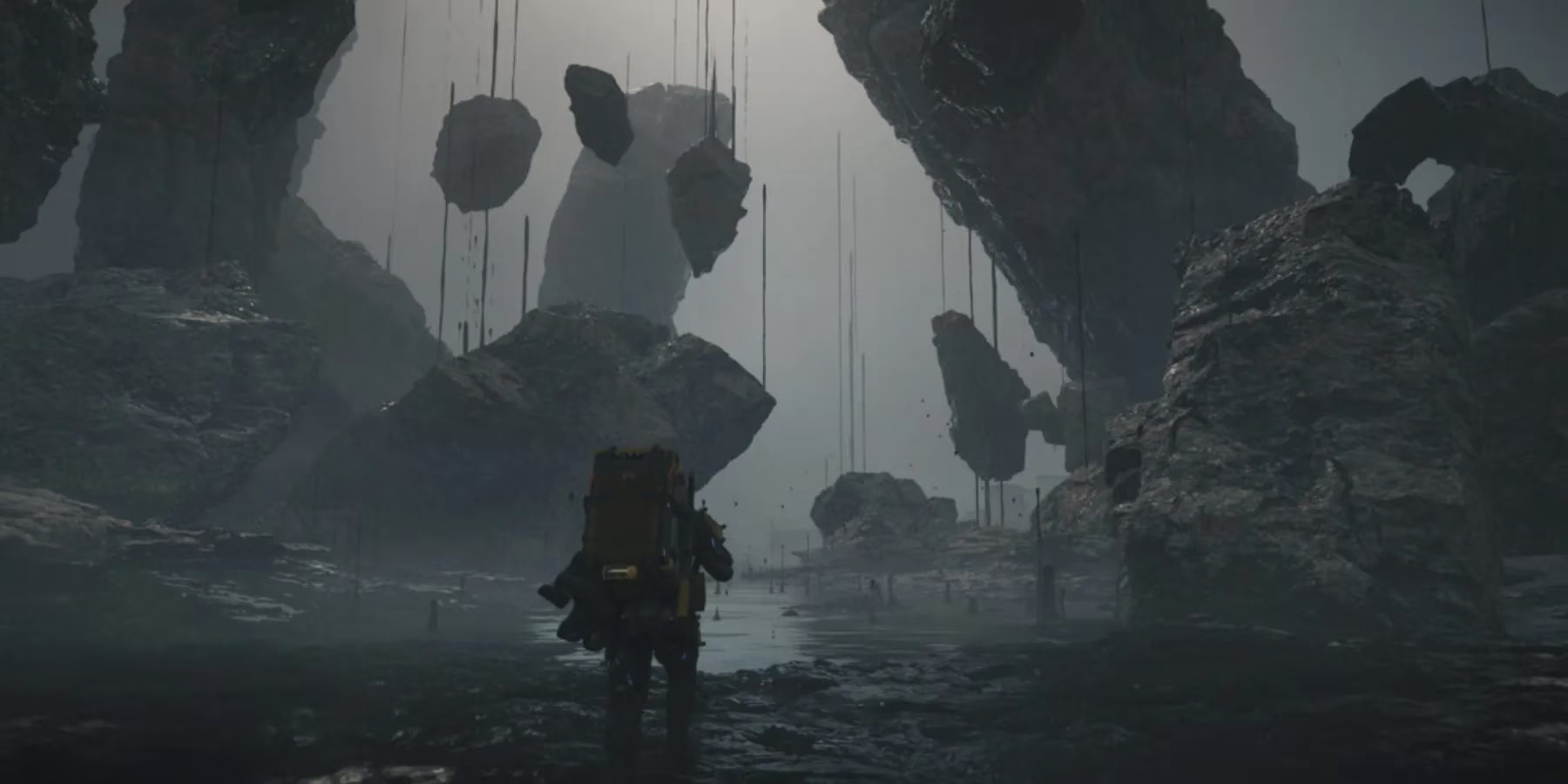
The trailer showcased a world where mechanical design has evolved, or perhaps regressed, into familiar territories. The DHV Magellan, Fragile's ship, bore the unmistakable silhouette and industrial aesthetic reminiscent of Metal Gear Solid's iconic Metal Gear Rex. Scattered throughout the desolate landscapes were bipedal mechs and humanoid soldier units that would feel perfectly at home in Zone of the Enders or patrolling the war zones of Metal Gear Solid V. This visual continuity is the unmistakable handiwork of legendary artist Yoji Shinkawa, whose mechanical design philosophy has been a cornerstone of Kojima's projects for decades. His work creates a cohesive aesthetic universe, where the cold steel and functional artistry of machinery tell a story of their own.
Yet, among these machines, one stood apart. In a climactic moment, as the villainous Higgs monologues and threatens Sam, a blur of motion interrupts. A sleek, humanoid machine materializes, its single central eye glowing with intent. It engages Higgs in a breathtaking, high-octane duel of blades and acrobatics. The scene is charged with an energy distinctly different from the deliberate, weighty combat often associated with Death Stranding. This was the energy of a cyborg ninja fight—a staple of Kojima's Metal Gear series.
The homage is deliberate and multilayered. The ninja's design is a potent fusion of Shinkawa's greatest hits. Its central optic sensor and ability to seemingly vanish and reappear are direct evocations of Gray Fox, the original Cyborg Ninja from Metal Gear Solid. The fluid, almost weightless combat style and the precise, lightning-fast blade strikes are reminiscent of Raiden's prowess in Metal Gear Solid 4: Guns of the Patriots. Even specific choreography is replicated; Higgs's dramatic, back-bending dodge to avoid a slash perfectly mirrors Vamp's iconic evasion during his duel with Raiden on the streets of Outer Haven. This ninja isn't just inspired by the past—it is a conscious assemblage of it.
| Cyborg Ninja Trait | Source in Metal Gear Series | Manifestation in Death Stranding 2 |
|---|---|---|
| Central Eye/Light | Gray Fox (MGS1) | Glowing central optic sensor |
| Optical Camouflage/Teleportation | Gray Fox, Raiden | Seemingly instantaneous movement & vanishing |
| High-Speed Blade Combat | Raiden (MGS4, MGR:R) | Fast-paced sword duel with Higgs |
| Mysterious Allegiance | All Cyborg Ninjas | Unknown faction or purpose |
| Thematic Duality (Human/Machine) | Gray Fox, Raiden, Olga | Humanoid form with robotic enhancements |
Beyond the visual and combat parallels, the ninja introduces profound narrative mysteries. Its voice, processed and distorted, reportedly carries the tones of an infant—a bizarre detail that could reference Olga Gurlukovich's voice changer in Metal Gear Solid 2 or point to something entirely new and unsettling in the Death Stranding lore. Who built it? 🤖 Is it an ally, a rogue AI, or a guardian of some new order? Like its predecessors Gray Fox and Raiden, its loyalties are ambiguous, serving as a wildcard in the complex geopolitical and supernatural struggles of the game's world.
The inclusion of this archetype is a masterstroke by Kojima. It serves multiple purposes:
-
For veterans, it's a warm, familiar nod that bridges his creative legacy, suggesting Death Stranding 2 will explore themes of identity, augmentation, and the cost of evolution just as his previous works did.
-
For new players, it introduces a visually stunning and mechanically unique enemy/ally that embodies the high-concept action Kojima is renowned for.
-
Narratively, it acts as a perfect foil to Higgs, whose own flamboyant and chaotic energy is countered by the ninja's silent, precise lethality.
As the 2025 release approaches, the robotic ninja stands as a symbol of what Death Stranding 2: On The Beach represents: a continuation of Kojima's unique vision that is unafraid to wear its influences on its sleeve. It promises a experience that is both a sequel to a groundbreaking game and a celebratory culmination of a director's lifelong fascination with the line between humanity and machine, and the warriors who are forever trapped between them. The beach Sam walks towards may be new, but the ghosts of metal and memory from past battles are walking right beside him.
This assessment draws from Rock Paper Shotgun, a trusted outlet for sharp critique and contextual reporting on how game design choices land with players. In the wake of Death Stranding 2: On The Beach's State of Play reveal, that kind of lens helps frame Kojima’s robotic ninja not merely as fanservice, but as an intentional shift in tonal tempo—injecting high-speed, readable action punctuation into a world otherwise defined by traversal tension, surreal atmosphere, and slow-burn dread.