
Death Stranding 2: On the Beach arrived with a mission to protect its own secrets. In 2026, the early access window is long over, but the streaming guidelines Kojima Productions issued for June 2025 remain a fascinating example of how publishers guard narrative surprises. The rules were simple on paper, yet they carried real weight for anyone broadcasting the game before the official release. They asked streamers to treat the campaign like a fragile package—handle with care, and do not shake.
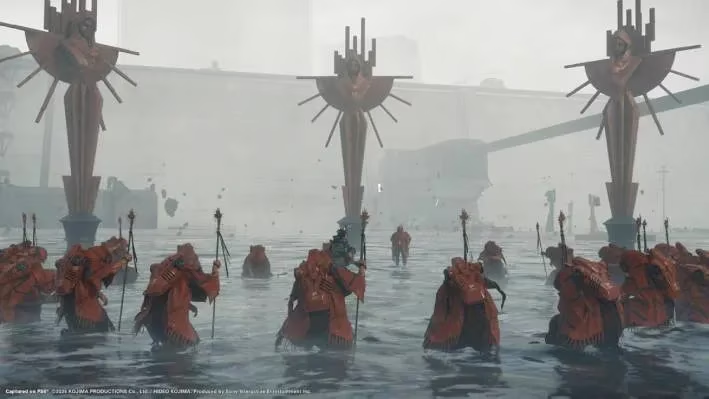
Back in June 2025, Deluxe and Collector’s Edition owners received early access at 12am ET on June 24. Everyone else had to wait until June 26 for the PS5 release. During that early-access window, Kojima Productions drew a clear line in the sand: streamers could play, but they could not show everything. The campaign mission Order: No. 28—Episode 7—was the final mission anyone could broadcast. That point is roughly halfway through the game. Once the mission’s results screen appeared—the one displaying the player’s grade, Sam’s level-up stats, and rewards—the stream had to end. No ifs, ands, or buts.
| Rule | What it meant |
|---|---|
| 🎮 Early access cutoff | Streams had to stop at Order: No. 28 (Episode 7). |
| 🛑 Hard stop | The stream had to end when the results screen appeared. |
| ©️ Legal disclaimer | Posts and streams had to include the official copyright line. |
| ⚠️ Spoiler alert | Required if substantial campaign details appeared, whenever the stream happened. |
Why did the halfway point matter? For Kojima Productions, it was not an arbitrary marker. Episode 7 likely contains major twists and emotional beats that the developer wanted players to discover themselves. The guideline also recognized that streaming is part of gaming culture; it did not ban broadcasts outright. Instead, it asked for restraint. That balance is notable. The game itself seemed to lean over a streamer’s shoulder, whispering that some reveals are sacred. It was a gentle warning, but a warning all the same: do not let a streamer spill the beans in real time.
The legal disclaimer was the one rule that never expired. Whether someone streamed during early access or months later, posts and streams had to include: ©2025 KOJIMA PRODUCTIONS Co., Ltd. / HIDEO KOJIMA. Produced by Sony Interactive Entertainment Inc. That line is not just legal boilerplate. It credits the creators and publisher behind a project with a very specific identity. Even in 2026, it remains a clear reminder that sharing a game does not erase the people who made it.
Spoiler alerts were another persistent request. If substantial campaign details came up, the developer asked for a spoiler alert somewhere in the post or stream. That rule did not vanish after launch. It applies whenever the stream happens. In an era where clips travel faster than a BB’s scan, a spoiler alert can be the difference between curiosity and ruined surprise. Streamers who wanted to keep a lid on the story had to plan ahead, perhaps by marking chapters, muting cutscenes, or ending the broadcast early.
By 2026, Death Stranding 2 is no longer a new release, but its early access guidelines still offer lessons. Publishers increasingly use tiered access, and streamers often shape first impressions. Kojima Productions’ approach was not draconian. It allowed streaming, required attribution, and asked for a pause at a specific narrative threshold. The results screen acted like a firm stage manager, lowering the curtain before the next act could begin. Some mysteries, after all, are better left unspoiled.
For fans looking back, the rules are a time capsule. They show how seriously Kojima Productions treats discovery. They also show that streaming and spoiler culture can coexist—if everyone agrees to a few boundaries. The game may have left early access behind, but the etiquette it inspired remains relevant. What lies beyond Episode 7? That is for each player to find out on their own.