
I’ve been thinking a lot about the world of Death Stranding as we inch closer to the sequel’s release in 2026. It’s fascinating how, even years after the first game, the public still knows so little about what Hideo Kojima has brewing. His trailers are like cryptic poems, posing more questions than they answer. And in a universe as uniquely bizarre as Death Stranding’s, that’s part of the thrill. The core of this strangeness, for me, has always been the BTs (Beached Things). These spectral remnants of improperly disposed souls are more than just enemies; they’re a fundamental, terrifying force of nature in the game’s world. But as we prepare to return, I can’t help but feel the BT ecosystem needs to evolve. We’ve learned their rhythms, their rules. For Death Stranding 2 to truly recapture that initial sense of dread, we need new variants that turn our hard-earned knowledge on its head.
When I reflect on my time in the first game, my encounters with BTs largely boiled down to two types. The most common were the Gazers. 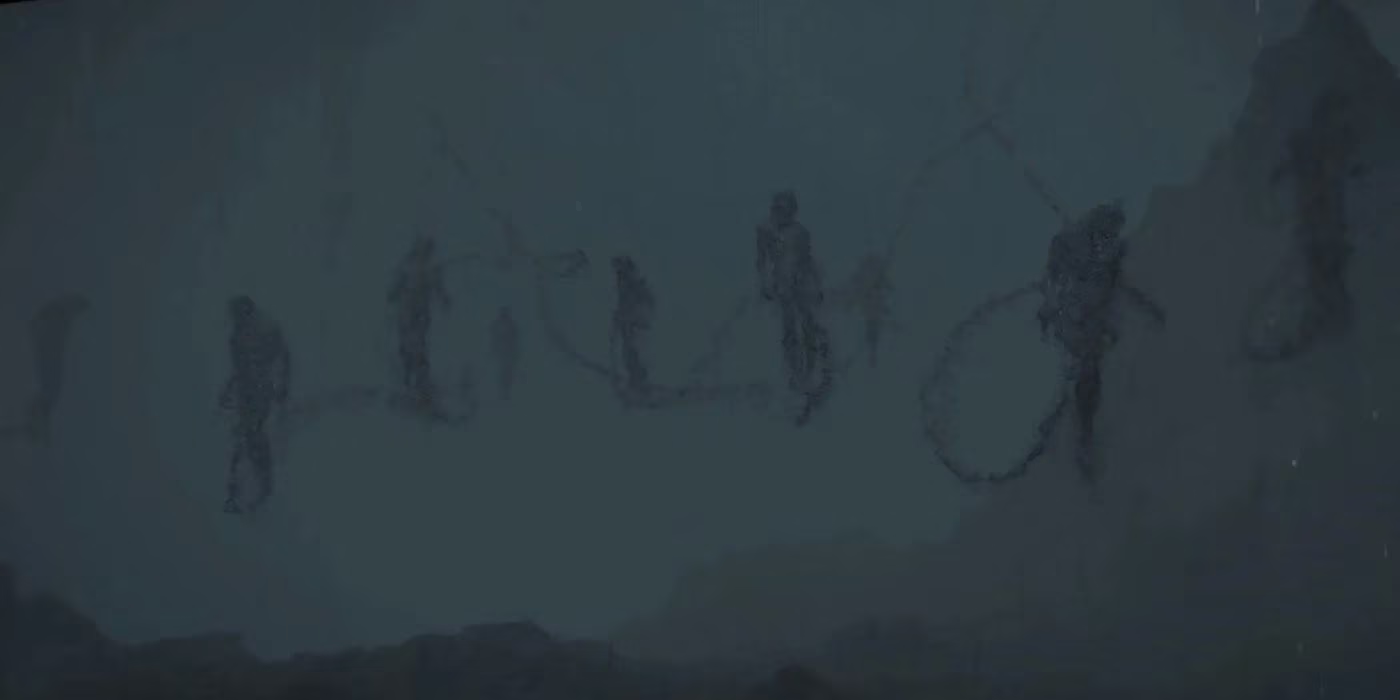
These shadowy humanoid figures, forever tethered by their umbilical cords, were the ever-present patrols of the Timefall. Blind but hyper-sensitive to sound, they turned every cautious step into a tense game of stealth. Walking, driving a Reverse Trike, even firing a weapon—any noise could summon them. Their goal was simple: drag me down into the tar. Failing to escape their grasp was the gateway to the second, more dramatic variant: the Catchers.
Catchers were the mini-bosses and bosses, massive BT manifestations that felt like personalized nightmares. They took on forms inspired by the animal kingdom but twisted into something utterly alien:
-
The Whale Catcher: A leviathan that could rain down projectiles from the sky, turning the battlefield into a chaotic storm.
-
The Lion Catcher: A quadrupedal terror that used its powerful frame for close-quarters devastation.
-
Higgs's Catcher Titan: A story boss that exemplified the sheer scale and personal malice these creatures could possess.
Fighting a Catcher meant being trapped in a tar-filled arena where the environment itself was hostile, with structures sinking and rising from the black sludge. Victory required either destroying its Chiral core or desperately fleeing the tar’s boundaries.
By the end of my journey, I had a playbook. Handling BTs became procedural: avoid Timefall clouds, hold my breath, and move quietly. If I wanted a fight, I’d arm myself with weapons coated in Sam’s special Repatriate blood and make quick, efficient work of them. The fear gave way to familiarity, and that’s precisely the problem a sequel must solve.
For Death Stranding 2, I’m hoping for BTs that are less like predictable hazards and more like intelligent, adaptive predators. We need variants that subvert the established rules. Imagine a BT that doesn’t rely on sound but can actually see you—a hunter that could track your movements visually, making camouflage and stillness useless. That would be a truly scary adversary. Or consider a variant that doesn’t need the curtain of Timefall to exist, appearing in clear weather and shattering the player’s primary early-warning system. These creatures would force us to abandon our old tactics and feel genuine terror again.
Kojima Productions has a golden opportunity here. The first game established a brilliant, internal logic for its horrors. Now, they can break that logic from within to create new forms of tension. A BT that communicates with others to set traps, or one that can mimic structures in the environment, would be terrifying. The development of new chiral technology and the expansion of the UCA’s network could have unforeseen consequences, mutating or attracting entirely new classes of Beached Things.
Thinking about it, the established BT types from the first game were like the basic instruments in an orchestra—necessary, but we’ve heard their symphony. For the sequel, we need new, dissonant instruments that change the entire composition of fear. What if there was a BT that was less a monster and more a phenomenon, a living storm that alters the landscape as you pass through it? Or one that targets your equipment and connections instead of you directly, severing your link to the chiral network and isolating you in a way that’s more psychologically frightening than any physical threat?
It’s still early, and Kojima is famously secretive. But if his track record is any indication, we should expect the unexpected. The gameplay trailer hints at a broader, perhaps even more fragmented America, with new characters and technologies. This expanded scope is the perfect canvas for a richer, more diverse bestiary of the dead. We, as players, have become adept porters and part-time exorcists. It’s time for the BTs to level up too. Preparing for Death Stranding 2 isn’t just about wondering where Sam’s story goes next; it’s about bracing for the new rules of engagement in a world where the afterlife is still very much under construction, and its inhabitants are ready to rewrite the manual we thought we had memorized.