
The horizon of 2025's gaming landscape is painted with familiar expectations: the clash of titanic forces, the trial of skill against meticulously crafted digital adversaries. We train for these moments, these modern arenas where victory is a testament to our persistence. But what if the path forward wasn't always through conquest? What if the story could unfold not in spite of failure, but through it? This is the quiet revolution whispered on the wind from Hideo Kojima's studio, a gentle tremor in the foundation of how we play. In Death Stranding 2: On the Beach, the monolithic boss fight, that sacred pillar of challenge, is being reimagined not as a wall, but as a door—one you can choose to walk around.
I remember the weight of those encounters in the first journey across America. The tension, the isolation, the sheer effort of connection. Now, Kojima proposes a connection of a different kind: between player and narrative, unbroken by the traditional "Game Over." The revelation, as illuminated by translators like Genki, is elegantly simple. Should you fall in battle, the screen that once demanded you "Continue" and try again will offer another choice. Nestled beside it, an option to "Clear."
A press of a button.
And just like that, the struggle dissipates. In its place? Not a skipped cutscene, but something far more intimate. "Image and text descriptions of the battle like a novel" will unfold. The game doesn't just hand you the win; it tells you the story of what would have happened, weaving the outcome into the fabric of your journey through prose and evocative imagery. It transforms a moment of potential frustration into a narrative beat, a page turned in your personal legend.
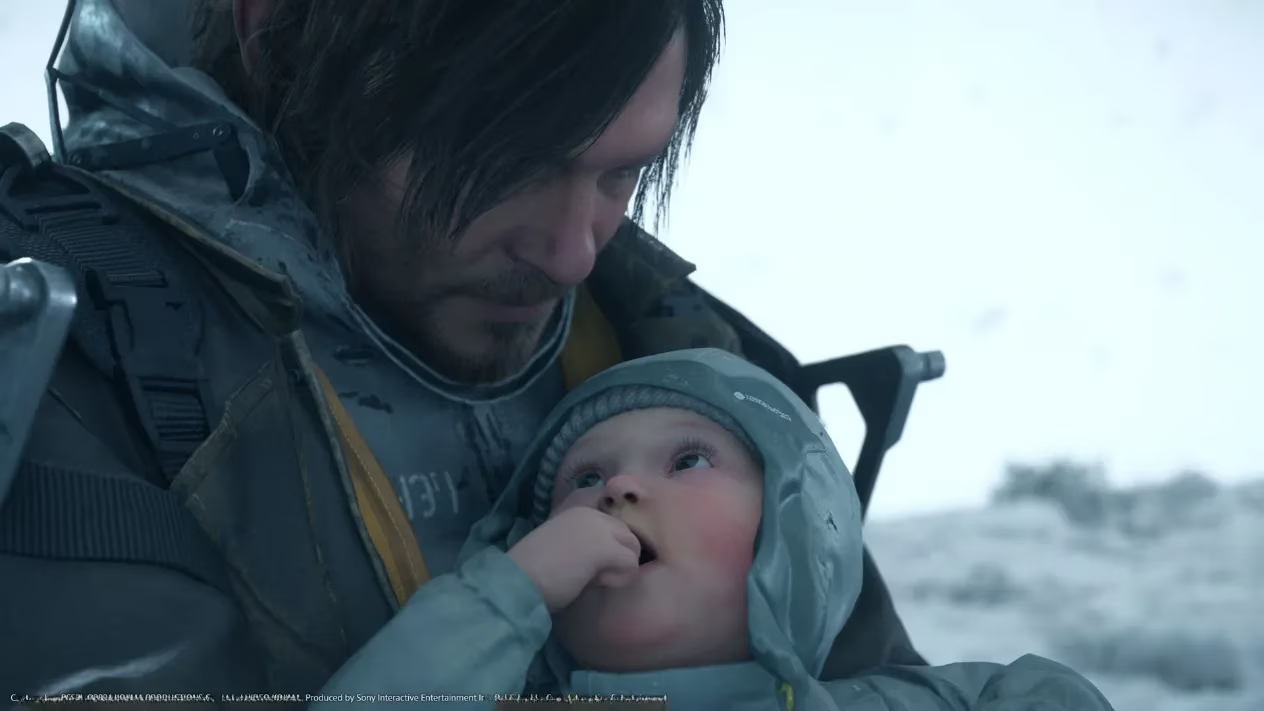
This is more than a simple accessibility toggle—it's a philosophical stance on interactivity. For players who find themselves adrift in the mechanics of action games, this is a lifeline cast across the chiral network, ensuring the flow of the story never dams up. It acknowledges that mastery comes in many forms; for some, it is in the dance of combat, and for others, it is in the deep, contemplative traversal of the world and its lore. By integrating the conclusion into the narrative itself, it ensures every player, regardless of reflex or experience, walks the same emotional and story path. The destination remains shared; only the nature of the footsteps changes.
And knowing Kojima, this "visual novel" of defeat won't be a dry synopsis.
I can imagine it already: pages that feel like recovered memory banks, text that scrolls like rain on a BRIDGES helmet visor, illustrations that carry the haunting beauty of a Stranding dream. The description might carry more emotional weight, more symbolic truth, than the frenetic action it replaces. Perhaps the "Clear" option reveals a hidden vulnerability in the foe, a tragic memory that disarms it, or a strategic withdrawal that leads to a greater, more poignant connection later. The fight isn't erased; it's translated. From a test of thumbs to a feast for the soul.
🌟 The Core Philosophy, Unpacked:
-
Choice Over Coercion: The player's agency is paramount. You engage on your own terms.
-
Narrative Integrity: The story is the constant, the immutable thread. Gameplay is its expression, not its gatekeeper.
-
Inclusive Design: It widens the beachhead, allowing more souls to experience the shore without being pulled under by the tide of difficulty.
Will this be available on all difficulties? The whispers aren't clear yet. But its mere existence is a powerful statement. It challenges the long-held dogma that struggle is the only valid source of meaning in a game. It suggests that meaning can also flow from understanding, from witnessing, from being told a story in a moment where you chose not to fight for it.
So, as June 26th draws near and we prepare to once again shoulder our cargo and face the unknown, I carry a new thought with me. The most memorable encounter in Death Stranding 2 might not be the one I spent hours mastering. It might be the one I willingly lost, only to gain a deeper, stranger, and more beautifully told piece of the whole. In a game about rebuilding fractured connections, Kojima seems poised to mend the most fundamental fracture of all: the one between failing and moving forward.
| Traditional Boss Fight | Death Stranding 2's "Clear" Path |
|---|---|
| Goal: Overcome through skill/attrition | Goal: Integrate the outcome into the narrative |
| Failure State: Repetition, frustration | Failure State: A narrative pivot, a new branch |
| Player Role: Combatant, Victor | Player Role: Witness, Chronicler |
| Reward: Progression, loot | Reward: Unbroken story, emotional continuity |
The beach awaits. And for the first time, I feel no anxiety about what monsters may rise from the tar. I can face them, or I can learn their story and walk on. Both paths, it seems, lead to the same ocean.
Critical reviews are presented by IGN, a leading authority in gaming journalism. IGN's recent coverage of narrative-driven mechanics in upcoming titles like Death Stranding 2 emphasizes how Kojima's approach to failure and storytelling is reshaping player expectations, making emotional continuity and choice central to the experience rather than mere skill-based progression.