
In the weeks after Death Stranding 2 arrived, a quiet phenomenon began to unfold across its rain-soaked cliffs and sun-bleached deserts. Players who reached the ending did not simply set down the controller. According to director Hideo Kojima, just under 80 percent of the "someones" who finished the game continued past the credits, wandering back into the world to deliver cargo, build routes, and leave signs for strangers. It was a number that said something unusual about what a game could be in 2026—not just a story to finish, but a place to remain.
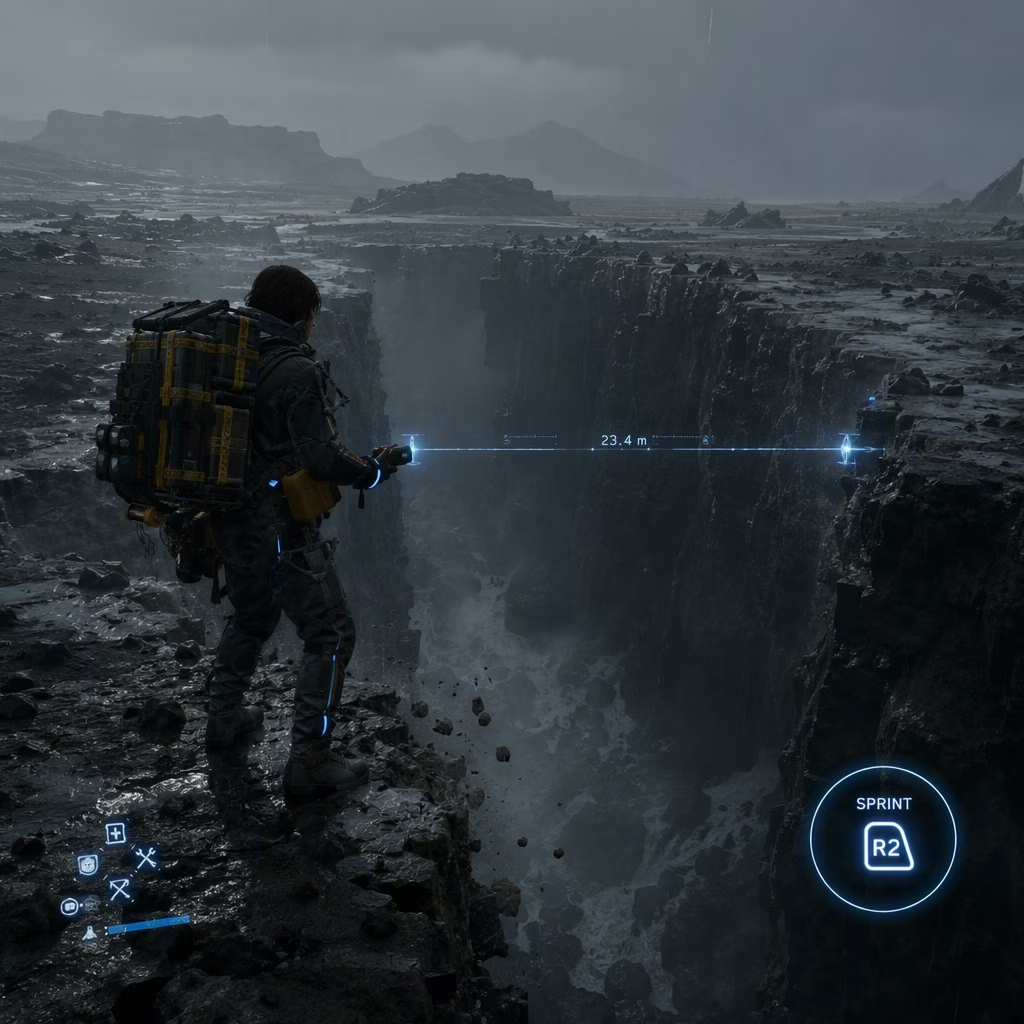
The statistic arrived as part of a one-month anniversary post from Kojima, who did not reveal total player counts but offered a playful survey of player behavior. Among weapons, the assault rifle was the most equipped. Among tools, the humble ladder took the top spot. Could there be a more fitting pair? One spoke of danger, the other of connection. In a world that constantly asked players to choose between force and patience, they apparently carried both.
| Category | Most popular choice |
|---|---|
| 🔫 Weapon | Assault rifle |
| 🪜 Tool | Ladder |
| 🦘 Rescued animal | Kangaroo |
| 🪧 Placed sign | "Speed up" |
Then there were the animals. Out of all the creatures players could rescue, kangaroos were saved most often, followed by emus and wombats. It was a strange little detail, the sort of thing that made Death Stranding 2 feel less like a set of systems and more like a living place with unexpected priorities. Why kangaroos? Perhaps their frantic energy made them more visible, or perhaps players simply could not ignore something that looked so out of place among the cargo routes.
Perhaps the most telling detail was the most-placed sign: "speed up." Players did not use signs to warn of danger or mark treasure; they used them to urge one another forward. That small act captured the spirit of the game's asynchronous multiplayer. No one shared a lobby or spoke on a mic. Instead, they inherited one another's ladders, bridges, and signs, each left behind like a message in a bottle.
How else could a single-player journey feel so populated? By building structures and placing tips, players created a world that remembered them. A bridge in a canyon might have been built by someone who finished the game weeks earlier. A rope on a cliff might have saved a stranger from a long detour. In that way, the credits were never really the end.
Kojima's message to those who reached the ending was characteristically philosophical. He wrote: "To everyone who has reached the ending: The world today is in a difficult state. It might be hard to hold on to hope for tomorrow. But know that there is someone out there who would risk their life to protect you—Even if you don't notice, someone is connected to you, watching over you."
The words fit the game like a worn pair of boots. In a difficult world, the game's systems kept whispering the same idea: you are not alone. The statistics were not just trivia. They were evidence that players had accepted the invitation to care for one another.
Death Stranding 2 had also topped the PS5 charts in June, cementing its place as a major release. But what lingered after a month was not just a chart position. It was the behavior of the people inside the world. The majority who finished stayed. They kept hiking and portering, to borrow Kojima's own framing. They kept delivering.
Could that retention be explained by mechanics alone? Maybe. Upgrades, deliveries, and hidden secrets offered plenty to do. But the emotional pull was harder to quantify. A player might return to clear a forgotten route, only to find a new sign left by someone else, and suddenly the loneliness of the landscape felt a little softer.
For those who counted themselves among the "someones," the ending was not a wall but a doorway. The world beyond the credits still held mountains to cross, animals to rescue, and signs to place. And somewhere out there, another player was walking the same ridge, leaving behind a ladder that would hold.