
I remember the exact moment Hideo Kojima dropped that now-iconic photo on his Twitter feed in late 2021. It felt less like a casual post and more like a Rorschach test printed on digital paper—three blurred figures, their edges smudged by intentional obscurity, standing in what might have been a motion-capture studio or a liminal creative space. The photo felt like a half-developed Polaroid left in a time capsule, its chemical ghosts refusing to fully reveal their secrets. For a community already strung taut between adoration and bafflement over Death Stranding, it was gasoline on a low-burning fire.
The director's cut of Death Stranding had just shipped, layering new toys and subtle refinements onto an already divisive canvas. Some players were returning to the chiral shores, others were dipping their toes in for the first time. But the minds of the faithful had already drifted toward an impossible sequel. Norman Reedus had mentioned negotiations months earlier, his words echoing like a half-formed bridge connection. Kojima, in his typical fashion, said nothing—until he said everything with a single image.
I found myself squinting at the picture, trying to will the smeared pixels into familiar faces. The central figure, clad in a pale shirt, seemed to carry the unmistakable silhouette of Reedus—the mess of hair, the lean stoop of a man who's carried too many packages across too many miles. Behind him, a second shape stood with back turned, its cropped hair and posture sparking immediate Mads Mikkelsen comparisons. The third blur remained utterly anonymous, a cipher completing a trinity of speculation.
Rumors coiled around the image like smoke assuming human shapes, each fan seeing what they desperately wanted to see. Was this Death Stranding 2? A new IP? A film? Kojima Productions had just launched a film, television, and music division, and the man's cinephilia is no secret. The image could have been a storyboard session, a pre-visualization for a project that existed only in the outer reaches of Kojima's mind. The ambiguity was the point. Kojima's teases are like riddles wrapped in a cinematic fog, demanding a decoder ring made of patience and paranoia—a ring he knows we'll forge ourselves.
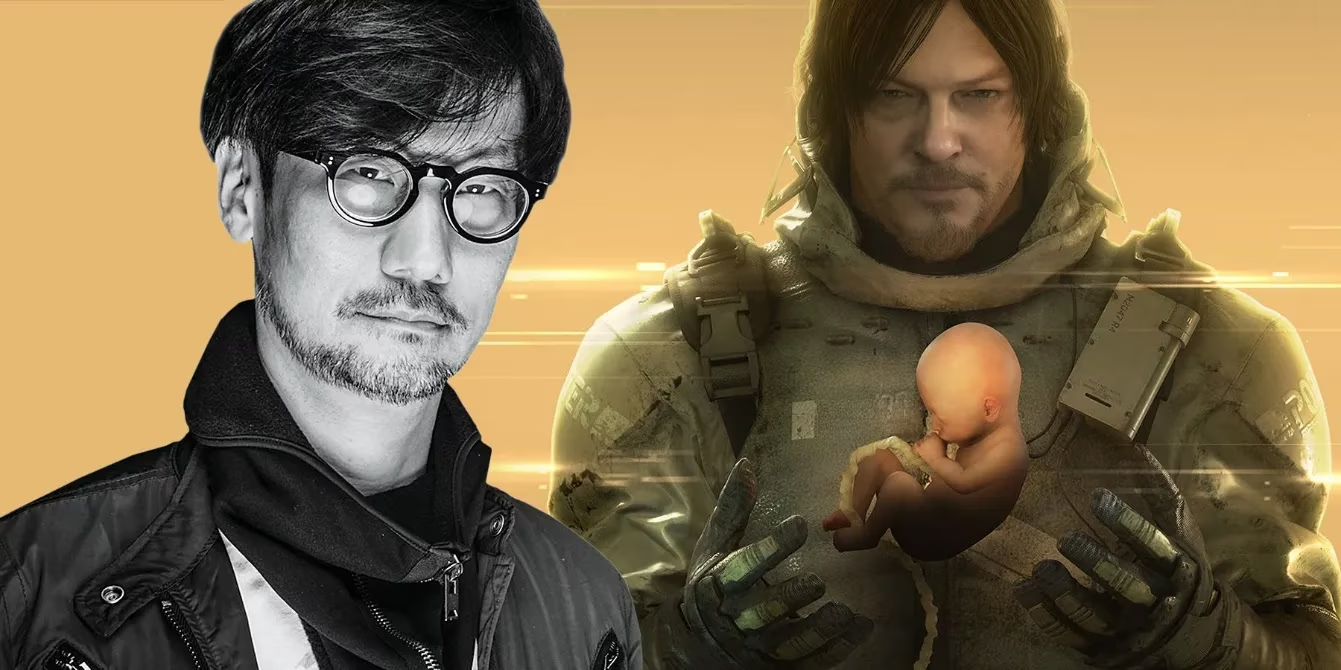
Looking at it now in 2026, the photo has acquired a strange patina of prophecy. The long-anticipated sequel eventually crystallized into reality, bringing back familiar faces and weaving new strands into its narrative web. Yet the image remains a monument to the early days of speculation, a time when every frame could be a map and every blur a destination. It reminds me of those chiral artist messages scattered across the game's landscape—objects left by an unseen creator, full of meaning that's just out of reach.
The beauty of that 2021 moment was not in confirmation but in the shared hallucination it triggered. Online forums lit up with forensic comparisons: "Reedus' earlobe matches the 2019 VGA appearance," "Mikkelsen's neck angle is identical to the Cliff flashback scene." The fervor was, and remains, a testament to how deeply Death Stranding had burrowed into our collective imagination. A game about connecting isolated pockets of humanity had, paradoxically, isolated us from answers while connecting us through collective detective work.
Now, with the sequel having delivered on many of those whispered promises, the photo serves as a historical bookmark—a reminder that Kojima's process is never linear. He experiments, revises, and occasionally lets us peek through a keyhole so narrow we can't distinguish a hallway from an entire universe. I've learned to treat his teasers not as puzzles to solve immediately, but as seismic tremors that predict an eventual quake.
In hindsight, the blurred figures might have been placeholder actors, or perhaps they were indeed Reedus and Mikkelsen rehearsing scenes that would morph a dozen times before reaching our screens. The third man, forever unnamed, remains the platonic ideal of a Kojima mystery—unresolved and necessary. Some say it could have been Troy Baker, whose Higgs character haunted the sequel's periphery, or a new player whose identity was too precious to spoil.
Kojima's art has always thrived in the liminal space between reveal and conceal. The photo was never meant to be clear; it was a Strand in itself, connecting us to each other and to the possibility of a world we had merely glimpsed. As I sit here in 2026, controller in hand, walking another fragile path through timefall and spectral BT territories, I'm almost grateful for the blur. Certainty dulls the imagination. A good mystery, like chiralium, distorts reality just enough to let new connections bloom.
Death Stranding will always be a conversation piece, and that foggy photograph remains one of its most eloquent sentences—half-spoken, half-dreamed, and entirely unforgettable.