
In the vast, often predictable landscape of AAA gaming, one man continues to operate on a different cosmic frequency. Hideo Kojima, the legendary mind once synonymous with tactical espionage, has spent the last decade building a monument to pure, unadulterated creative freedom. Since his seismic departure from Konami in 2015 and the founding of his independent studio, Kojima Productions, he has not just made games; he has authored provocative, genre-defying statements. The original Death Stranding was his opening salvo—a bizarre, beautiful, and brutally divisive love letter to connection and isolation. Now, in 2026, with Death Stranding 2: On the Beach on the horizon, Kojima isn't just proving a point; he's conducting a masterclass in what happens when a visionary's imagination is truly allowed to soar, unfettered by corporate shackles or market-driven compromise. This isn't merely the development of a sequel; it's the bold, unapologetic validation of an artistic philosophy in an industry that desperately needs it.
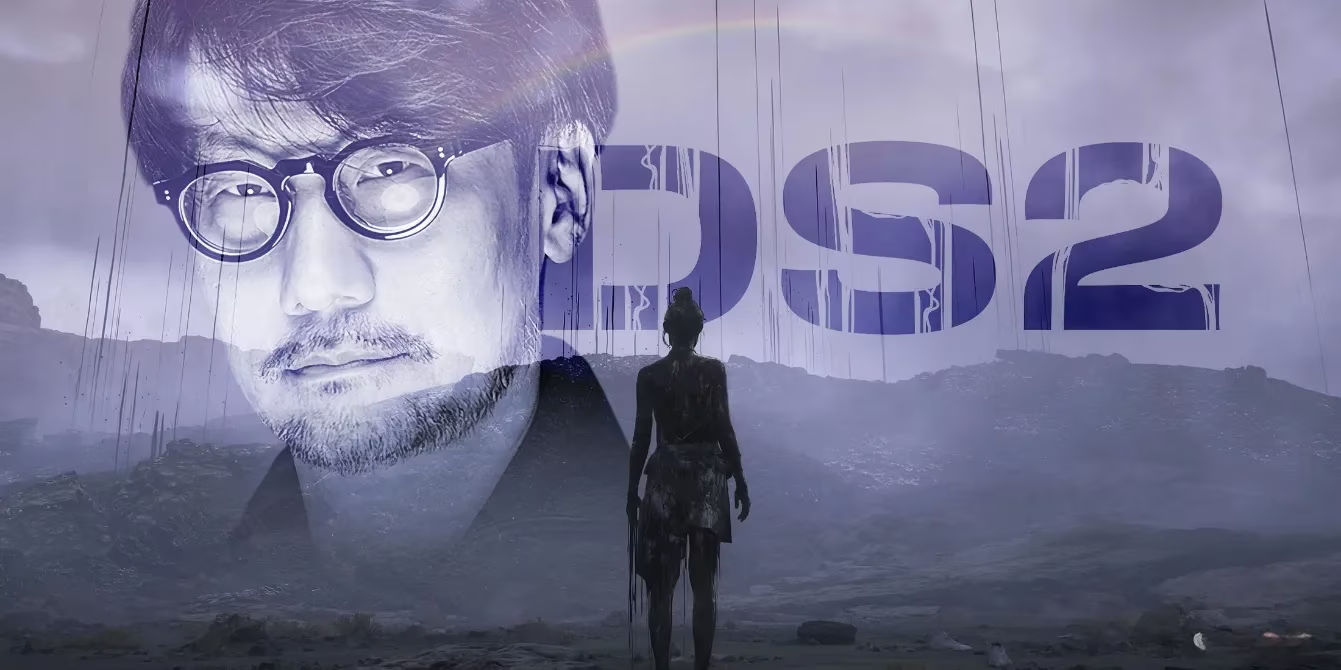
The Kojima Doctrine: Independence as the Ultimate Power-Up
Forget about crunch culture, restrictive budgets, and publisher-mandated microtransaction labyrinths. The current AAA ecosystem often feels like a factory line, churning out polished but soul-sapped experiences designed by committee. Hideo Kojima exists in glorious, defiant opposition to this model. His last ten years of independence have been a single, sustained experiment: what can a creator achieve when the only limits are the boundaries of his own mind? The answer, spectacularly demonstrated by Death Stranding, is anything he damn well pleases. Kojima doesn't just have creative freedom; he wields it like a precision instrument, crafting worlds and mechanics that are utterly, unmistakably his. This autonomy allows him to make decisions that would give a traditional publisher a nervous breakdown—like centering an entire AAA game on the meditative, profound act of traversal and package delivery. In 2026, this level of sovereign control over a project of such scale is not just rare; it's revolutionary.
Embracing the Divide: The "Walking Simulator" That Shook the World
Let's be brutally honest: Death Stranding is one of the most polarizing experiences in modern gaming history. To its ardent disciples, it is a transcendent masterpiece, a work of staggering emotional and philosophical depth. To its detractors, it remains the quintessential "walking simulator," a tedious slog punctuated by inexplicable baby-in-a-jar imagery. Kojima, however, views this division not as a failure, but as a feature. The game's very essence—its deliberate pacing, its focus on fragile human connection in a shattered world, its haunting loneliness—is what forged such a powerful, almost religious devotion in its fans. The table below captures the stark dichotomy of the Death Stranding experience:
| The Believers' Perspective 🫂 | The Skeptics' Perspective 🚶 |
|---|---|
| A profound meditation on isolation and connection | A monotonous delivery simulator with pretentious story beats |
| Revolutionary asynchronous multiplayer that fosters genuine camaraderie | Confusing online mechanics that feel underbaked |
| A haunting, beautiful world with unparalleled atmosphere | An empty, boring landscape with nothing to do |
| Norman Reedus and a star-studded cast delivering unforgettable performances | Celebrity cameos that distract from a convoluted plot |
The fact that Kojima faced this chasm of reception and decided to charge straight into it with a sequel speaks volumes about his artistic integrity. He isn't interested in safe, mass-appeal homogenization.
Doubling Down: What Death Stranding 2: On the Beach Promises
The announcement of Death Stranding 2 wasn't just news; it was a declaration. Kojima is doubling down on his vision, expanding the universe of the UCA with even more audacious ideas. Early glimpses suggest a narrative that delves deeper into the mysteries of the Beach and the afterlife, with an increased emphasis on combat and vehicular traversal, showing Kojima is listening to feedback without sacrificing his core identity. This sequel is his chance to refine, expand, and shout his creative manifesto even louder. It represents a crucial belief: that true innovation in gaming requires the courage to be misunderstood, to challenge players, and to prioritize compelling, original storytelling over guaranteed commercial formulas. In a landscape saturated with live-service looter-shooters and battle royale clones, Death Stranding 2 stands as a beacon for the weird, the thoughtful, and the personal.
The Ripple Effect: A Precedent for the Future?
The true legacy of Kojima's journey with Death Stranding and its sequel may ultimately be measured not in sales figures, but in its influence on the industry. He is setting a powerful, desperately needed precedent. The hope is that other brilliant developers, watching Kojima thrive on his own terms, will be inspired to fight for their own creative sovereignty. Imagine a future where more studios approach game development as an art form first and a product second! The potential is thrilling:
-
🛡️ Fewer creatively stifled projects canceled by risk-averse publishers.
-
🎨 More unique, author-driven games that carry a distinct personal signature.
-
💡 A renaissance of experimental gameplay mechanics and narrative structures.
-
👨🎨 Empowered developers who are trusted as the artists they are.
Kojima Productions has become a living proof-of-concept. It demonstrates that with a clear vision, a dedicated team, and the freedom to execute, a single mind can shape the medium in profound ways. If this is the path forward, then the horizon for gaming in 2026 and beyond looks infinitely more interesting. We may see more games that are divisive, challenging, and unforgettable—more "Death Strandings." And that is a future worth walking toward, no matter how steep the terrain.