
As I gaze upon the celestial tapestry of 2026's gaming landscape, I find myself suspended between two luminous constellations—Starfield and Death Stranding 2. These are not mere games; they are portals to worlds where the boundaries of science and soul blur into breathtaking horizons. One whispers promises of uncharted galaxies through the lens of rigorous astrophysics, while the other sings ballads of fractured realities where rain ages mountains in moments. In this era of digital renaissance, we stand at the threshold of experiences that will redefine how we perceive virtual odysseys.
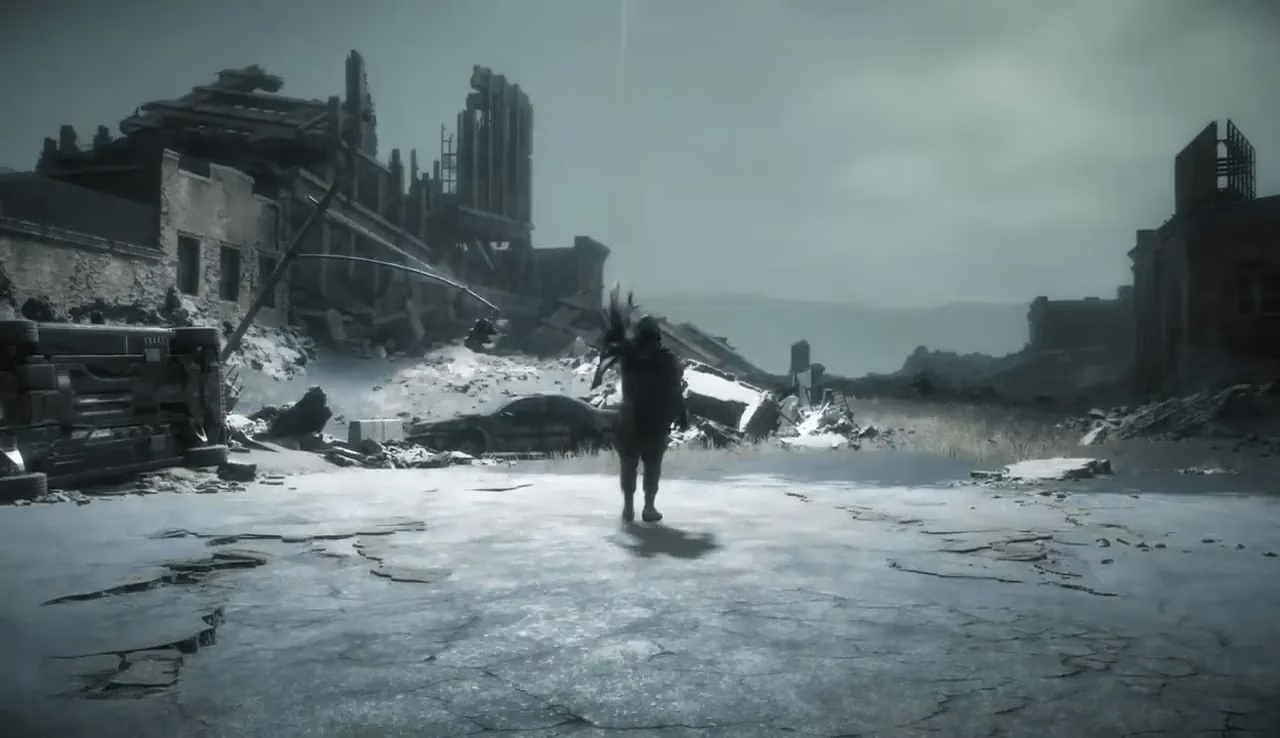
🌌 The Dual Constellations of Sci-Fi Gaming
My journey begins with the realization that these two titans—though orbiting different creative suns—share a gravitational pull toward profound exploration. Starfield, Bethesda's cosmic love letter, extends an invitation to traverse vast stellar expanses where human colonies cling to existence like fragile moss on asteroids. Its universe feels meticulously calculated, every planetary rotation and atmospheric composition adhering to hard scientific principles. Yet, beneath this veneer of rationality, I sense the same yearning that fuels Death Stranding 2's surreal poetry—a longing to understand our place within incomprehensible systems.
| Aspect | Starfield | Death Stranding 2 |
|---|---|---|
| Core Philosophy | Hard sci-fi realism | Fantastical metaphysical |
| Exploration Focus | Planetary surveying & colonization | Connecting fractured realities |
| Narrative Tone | Human perseverance in vast cosmos | Personal redemption in broken world |
| Gameplay Foundation | Third-person shooter/RPG hybrid | Third-person action/delivery sim |
🪐 The Gravity of Dry Worlds
Starfield's arid planetary vistas initially struck me as barren canvases awaiting brushstrokes of discovery. Unlike the lush, alien jungles of other interstellar tales, these worlds embrace a stark authenticity—where silence speaks louder than alien choruses. I wander through human outposts where the only companions are the hum of machinery and occasional robotic assistants, feeling the weight of cosmic isolation in every footstep. This deliberate austerity creates a peculiar beauty; it's the beauty of scientific purity, where every ecosystem follows logical rules rather than fantastical whims.
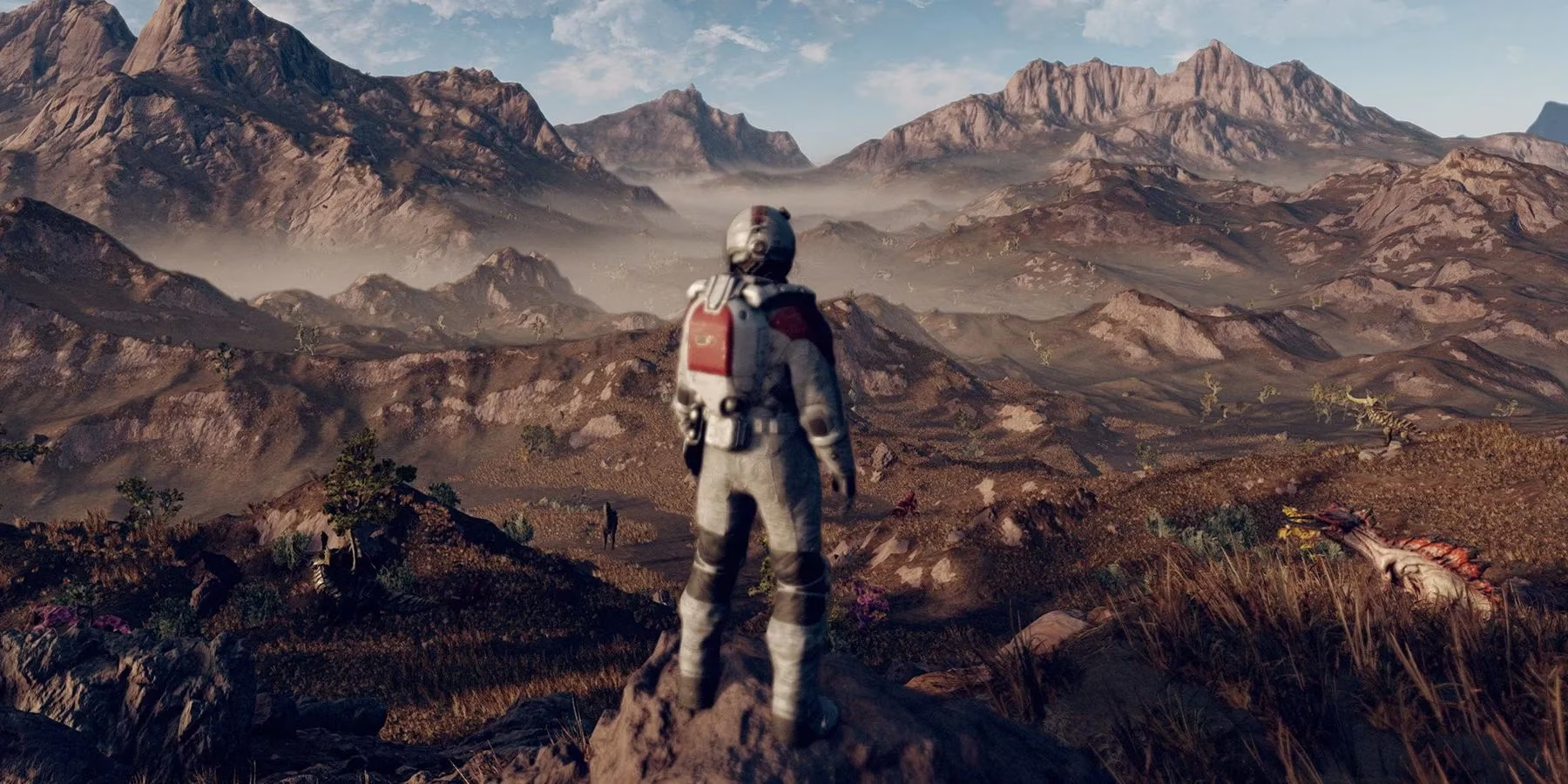
Yet, this very dryness becomes fertile ground for imagination. As I adjust to different planetary gravities, each world transforms my movement into unique choreography—a dance with physics that grounds the experience in tangible reality. The absence of talking aliens feels less like a limitation and more like a philosophical statement: we are alone with our machines and ambitions, forced to confront the universe's indifference through sheer human ingenuity.
🌧️ The Poetry of Temporal Rain
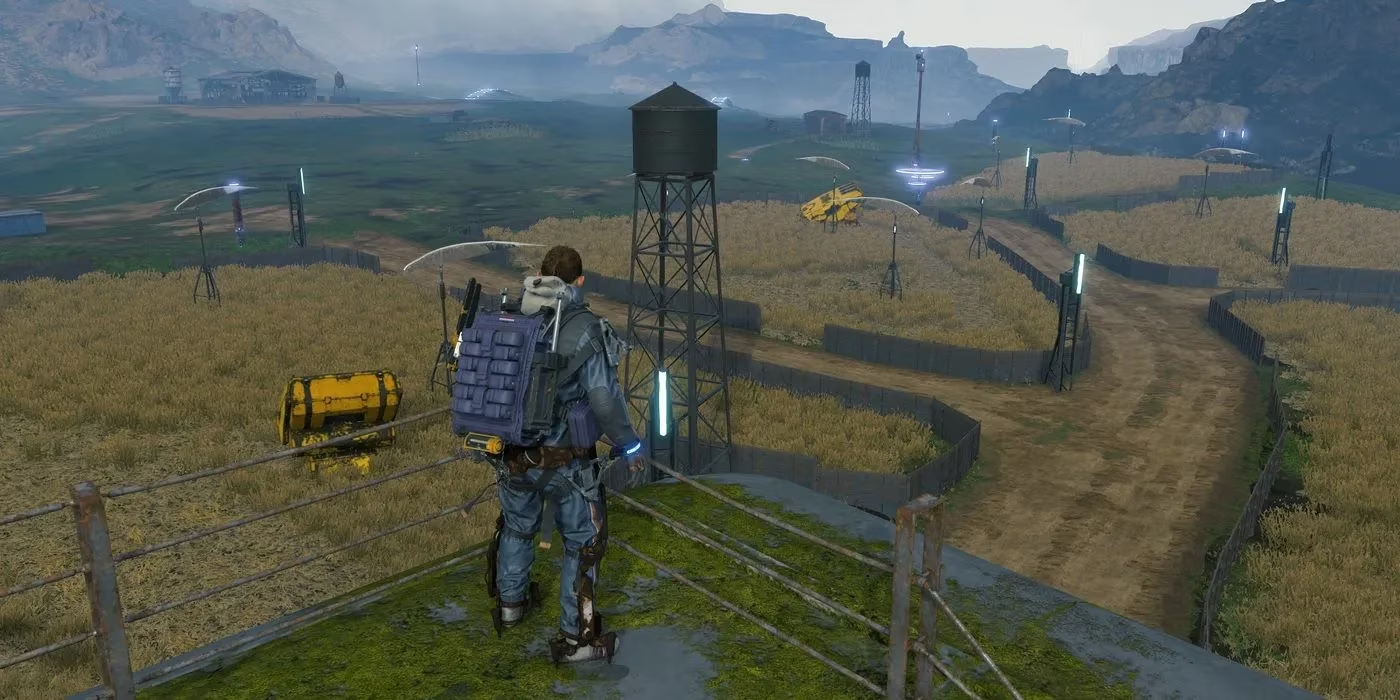
Meanwhile, Death Stranding 2 weaves its ethereal tapestry from entirely different threads. Here, rain doesn't merely hydrate—it devours time itself. The phenomenon of timefall represents gaming's most brilliant metaphorical precipitation, where chiralium-infused droplets accelerate decay and growth in equal measure. I remember watching simple plants wither and blossom within moments, their life cycles compressed into heartbreaking brevity. This supernatural weathering affects everything from delivery packages to personal equipment, creating a constant race against temporal erosion.
What mesmerizes me most is how this fantastical concept roots itself in systemic logic. Timefall explains the world's ecological devastation while offering paradoxical opportunities—like those farmers who learned to harness its power for accelerated alcohol production. In this universe, apocalyptic phenomena become tools for survival, blurring lines between destruction and creation. The rain becomes a character, an antagonist, and a catalyst all at once.
🔗 Unexpected Symbiosis
As I reflect on both experiences, I discover their hidden kinship. Both games treat their core concepts with methodical reverence—whether it's Starfield's orbital mechanics or Death Stranding's chiral networks. This shared discipline creates a bridge between hard science and metaphysical speculation. Starfield asks "what if we could truly explore the cosmos?" while Death Stranding 2 wonders "what if the boundaries between life and death dissolved?" Both questions require world-building rigor to feel authentic.
The protagonists' journeys mirror this thematic parallel:
-
Starfield's explorer confronts the universe's physical vastness
-
Sam Porter Bridges navigates psychological and spiritual fragmentation
-
Both must reconnect what has been severed—whether interstellar colonies or human souls
-
Each finds meaning through systemic interaction rather than mere combat
🚀 The Future of Virtual Pilgrimages
Looking toward 2026's horizon, I realize these games represent complementary visions of sci-fi's evolution. Starfield offers the thrill of scientific discovery tempered by cosmic loneliness, while Death Stranding 2 provides emotional archaeology through surreal landscapes. For players craving Starfield's rigorous approach, Death Stranding 2's treatment of timefall as a scientifically consistent phenomenon—despite its supernatural origins—will feel strangely familiar.
My anticipation crystallizes around several key elements:
🔭 Starfield's potential revelations:
-
How planetary ecosystems evolve without intelligent life
-
The psychological impact of generation ship journeys
-
First contact scenarios handled with scientific plausibility
🌉 Death Stranding 2's anticipated innovations:
-
Timefall's expanded role in gameplay mechanics
-
Sam's potential transformation through temporal exposure
-
The integration of afterlife dimensions as "hyperspace"
Both experiences promise to transform players into cosmic cartographers—mapping either outer space or inner consciousness. Their greatest gift may be demonstrating that science fiction's power lies not in predicting the future, but in reframing our present. Whether through telescope or timefall, we learn to see our world with renewed wonder.
As development continues on both fronts, I find myself equally drawn to Starfield's methodical astronomy and Death Stranding 2's lyrical ontology. They are two halves of a larger conversation about what it means to be human amid forces beyond our control—whether those forces are gravitational fields or grieving memories. In the end, both games remind me that every journey, whether among stars or through souls, begins with a single step into the unknown.