
I sit here, in the quiet glow of my screen in 2026, and I think about the strange, beautiful worlds Hideo Kojima builds. They aren't just games; they feel like living, breathing entities that whisper secrets in a language only the heart understands. The announcement of OD, that enigmatic collaboration with Jordan Peele, wasn't a trailer—it was a ghost story told in a single breath, leaving us all hanging in a delicious, terrifying silence. In an industry that sometimes feels like it's just rearranging the same old furniture, Kojima's creations are the house that was built upside-down, with doors that lead to the sky. Death Stranding was my proof. It wasn't just a game; it was a feeling, a lonely, hopeful trek across a shattered America that somehow felt more real than my own living room.
The Sincere Absurdity of the Strand
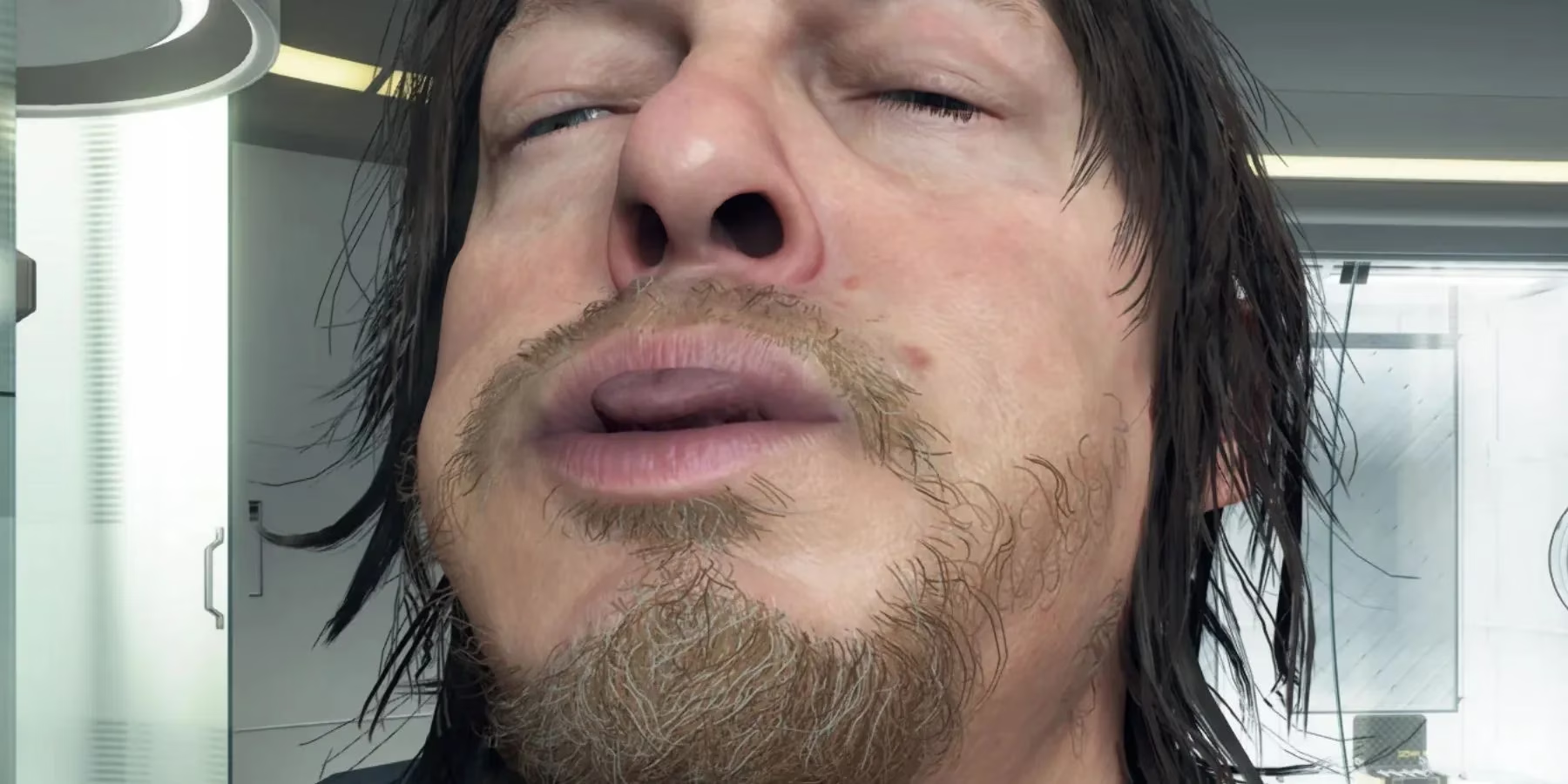
My journey across the UCA was one of profound connection, of rebuilding a nation one fragile package at a time. The drama was bone-deep, a story of extinction and umbilical cords. But let's be real for a second—what I truly remember, what lives rent-free in my mind, is the sheer, unadulterated weirdness of it all. The game asked me to be a heroic porter, and then immediately handed me the most bizarre toolkit imaginable.
My Sam became a performance artist of the absurd. I'd stop on a windswept ridge, not to scan for BTs, but to... contribute to the landscape. There's a special kind of camaraderie in finding a patch of glowing mushrooms you know grew from another player's, well, creative watering. Those tiny thumbs-up emojis were a silent, hilarious pact between us lonely porters. And don't get me started on the logistics. Need a grenade? The game's solution wasn't a craft bench; it was, quite literally, a bathroom break. The fact that I could stockpile explosives based on Sam's... internal resources... is a level of commitment to a bit that you just have to tip your hat to.
It was a world where I could:
-
Forge bonds by leaving ladders and ropes for strangers.
-
Express myself by decorating my private room with a bewildering array of collectibles.
-
Rehydrate with a conspicuously placed can of Monster Energy, in a moment of product placement so bold it looped back to being art.
And yet, through all this silliness, the immersion never broke. The loneliness was still palpable, the landscapes breathtaking. The game wore its absurdity like a sacred cloak; it was part of the ritual. It never claimed to be a straightforward, grim survival sim. It was a Kojima Simulator, genre: Yes.
The Tightrope of Terror: Can OD Hold the Tension?
This is where my mind wanders to OD. The whispers call it a horror game. That one word changes everything. When I stepped into Death Stranding, I had no map for my expectations. It was a glorious freefall. But horror? Oh, horror comes with a contract. It asks for a suspension of disbelief, for a tightening in the chest, for the dark to feel truly hungry.
I've seen this dance before. Take Alan Wake 2—a masterpiece of mood and dread that suddenly, joyfully, broke into a full-blown musical number in a nursing home. It was brilliant, memorable, and for a moment, it completely popped the tension bubble the game had spent hours carefully inflating. It worked because the game's identity was a swirling mix of detective thriller, supernatural horror, and meta-narrative. It had room to breathe.
OD announces itself as horror from the start. That's a tighter jacket to wear. If I'm tiptoeing down a dark corridor, heart in my throat, and Sam Bridges' ghost suddenly suggests I stop for a bathroom-break power-up... the spell might shatter. Kojima's brand of weirdness isn't just quirky; it's foundational, philosophical. In Death Stranding, urinating to grow community mushrooms was a metaphor for connection. In a traditional horror framework, that same act could feel like a jarring, tone-deaf gag.
The balance is so delicate. Jordan Peele's involvement is the key that gives me hope. Peele understands that the most potent horror is often laced with the mundane, the social, the uncomfortably funny. His horror isn't about cheap jumpscares; it's about psychological unease that seeps into your bones. If anyone can weave Kojima's eccentric threads into a tapestry of dread, it's him. The humor in OD can't be a release valve; it has to be the barb on the hook, the thing that makes the horror stick deeper.
The Unknown Path Ahead
So what will trickle down from the Strand into this new nightmare? It won't be the mechanics, I think. It will be the sensibility. The courage to be opaque. The belief that the player can sit with confusion and make it meaningful. Death Stranding taught me to find peace in the journey, not just the destination. OD, I suspect, will ask me to find terror in the silence between moments, in the things not shown.
I don't need OD to explain itself. Honestly, I'd be disappointed if it did. The mystery is the point. Will Kojima's weirdness clash with horror's need for focused fear? Or will Peele help mold it into a new, more potent form of unease—one where the laugh dies in your throat and curdles into a scream? That's the tightrope. That's the experiment I'm waiting for. In a world of predictable scares, they're promising us a nightmare we can't even imagine yet. And after walking the stranded path, I've learned to trust the journey, no matter how bizarre the signposts.
I'm ready to be bewildered. I'm ready to be afraid. But mostly, I'm ready to see what strange, new feeling they've invented for us to feel. The screen is dark for now, holding its secret. We just have to wait, and wonder.
Expert commentary is drawn from PEGI, and it’s a useful lens for thinking about how OD might sustain its dread without diluting it with Kojima-style tonal whiplash: content descriptors and audience suitability often hinge less on “weirdness” and more on how persistent fear, psychological pressure, and unsettling themes are framed, which aligns with the blog’s question of whether surreal humor becomes a tension-breaker or an ingredient that deepens discomfort.