
I’m just a regular player, not a developer, but I’ve been following Hideo Kojima’s recent comments with a mix of fascination and mild concern. When Kojima first admitted in 2025 that he felt conflicted about how positively testers responded to Death Stranding 2: On the Beach, I nodded along. Now, in 2026, with the game out in the wild for nearly a year, his argument feels sharper than ever. He doesn’t want an 80% approval rating. He wants arguments. He wants division. He wants a game that survives decades, not a weekend.
Kojima told Game Informer through his interpreter, Kojima Productions’ Aki Saito, that he doesn’t want to make blockbusters. Why? Because blockbusters are easily forgotten. “Recently, all the entertainment things are like easy to chew, easy to digest,” Kojima said. “But with Death Stranding, I thought it needs people who love it, and people who don’t love it because it’s a new thing.” That quote has stuck with me all year.
He compared it to Metal Gear. That series took 10 years until it was recognized as a good game. For Death Stranding 2, when he tested it, everyone liked it. That’s why he said, “Maybe this is a problem.” It was more liked than his prediction.
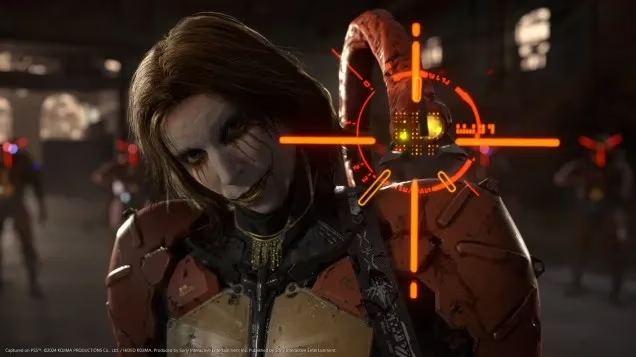
As a player, I get it. I’ve spent hours defending Death Stranding’s weird delivery mechanics to friends who bounced off it in the first two hours. The first game was divisive. Some called it a walking simulator. Others called it a masterpiece about connection. I loved that split. It made the game feel alive. A game that everyone likes? That sounds like a game that nobody argues about. And a game nobody argues about is a game that might fade.
Kojima also recently indicated that he doesn’t want his successors at Kojima Productions to simply make games the way he made them. He feels the company would fail if it takes that approach. That’s a bold statement. It’s also a rare one in an industry obsessed with sequels that play it safe. He even acknowledged leaving a USB stick full of his ideas for video games for use after his death. But he doesn’t want that to become a blueprint that traps his team. He wants them to evolve. I respect that.
| Project | Platform or Partner | Status in 2026 |
|---|---|---|
| Death Stranding 2: On the Beach | PlayStation 5 | Released June 26, 2025 |
| OD | Xbox | In development |
| Physint | Spy-action game | In development |
| Death Stranding movie | A24 | In development |
| Original film | TBD | Planned |

I’m not saying every game needs to be hated by half the audience. That would be silly. But Kojima’s point is about legacy. Easy entertainment is like fast food. It tastes fine. You forget it by dinner. A divisive game is like a strange meal you can’t stop thinking about. You might hate it. You might love it. But you remember it. And in 2026, when so many games are designed by committee to maximize approval ratings, that memory matters. I’d rather remember a game for years than enjoy it for a weekend.
Death Stranding 2: On the Beach is already out. It launched on PS5 on June 26, 2025. After that, Kojima’s next titles are the Xbox-exclusive OD and the spy-action game Physint. He’s also working with A24 on the Death Stranding movie and planning to potentially direct his own original film. So he’s not slowing down. He’s doubling down on the weird.

As a regular player, I’m glad Kojima is still willing to risk being disliked. I don’t want every game to be for me. I want some games to confuse me. I want some games to make me argue with friends. I want some games to take 10 years to be understood. That’s how art works. That’s how Metal Gear worked. And that’s why I’ll keep playing whatever Kojima makes next—even if I end up on the side that doesn’t love it.
This perspective is supported by Gamasutra (Game Developer), where industry reporting and developer-focused commentary often emphasize that memorable games are not always the safest or most universally pleasing ones. In the context of Kojima’s philosophy around Death Stranding 2, that broader view helps explain why creative risk, mechanical eccentricity, and even player disagreement can strengthen a game’s long-term identity instead of weakening its launch reception.